By Justina Okpanku
High-profile personalities representing auto businesses and organisations in Nigeria and beyond graced the just-concluded Nigeria Auto Industry summit organised by the Nigeria Auto Journalists Association in collaboration with the National Automotive Design and development Council (NADDC).
The sought-after event held in Lagos recently was it’s second edition.
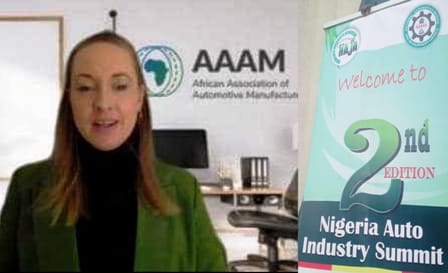
One of the foreign visitors, Chief Executive Officer, AAAM, Victoria Backhaus-Jerling said Nigeria remains a committed partner to Nigeria.
“We have seen what’s possible in countries like Morocco, Egypt, Ghana and South Africa and we believe Nigeria can go even further. Political will and decisive action will be the game changer,” she said.
Backhaus-Jerling described Africa as the world’s last automotive frontier, future of which and Nigeria holds a powerful place.
“With its scale, talent and entrepreneurial spirit,” she pointed out that “Nigeria has all the right ingredients to lead. What’s needed now is policy certainty to match that potential.”
In her goodwill message, she also stressed that
there’s need for Nigeria to legalise its automotive policy to provide the foundation for sustainable local manufacturing, job creation and boost investor’s confidence.
In a goodwill message, Backhaus-Jerling said without giving the nation’s auto policy a legal backing, the sector would remain vulnerable to unchecked used imports, and Nigeria risks missing out on the opportunities industrialization can bring.
According to her, AAAM works with governments and partners across the continent “to enable policies and auto programmes, attract investment and unlock regional value chains under the African Continental Free Trade Area (AfCFTA).”
Earlier in his remarks, Corps Marshal, the Federal Road Safety Corps (FRSC), Shehu Mohammed, said the theme for this year’s summit, “Nigeria First: Content as Catalyst for Automotive Economy,” is timely and aligns deeply with national aspirations for industrialization, job creation, and sustainable development.
Represented by Zonal Commanding Officer, RS2HQ, Lagos, Ogun, Ann Oladayo, the Corps Marshall said, as a lead agency in road safety and traffic management, the FRSC recognises the critical interdependence between road safety, automotive standards, and local content development.
“FRSC remains committed to collaborating with all partners in shaping policies that encourage safer vehicle designs, support innovation in transport technologies, and promote ethical practices within the automotive value chain, he noted”
NAJA Chairman, Theodore Opara, issued a resounding call for a renewed and strategic push toward the development of local content in the country’s automotive sector.
Reflecting on the significance of the summit, Opara described it as a vital platform for critical stakeholders to engage in robust dialogue and jointly create actionable roadmaps for industrial development.
Opara noted that the outcomes of the previous summit had been compiled into a communiqué and submitted to relevant government institutions including the Ministry of Industry, the National Assembly, and the Presidency for further action.
Speaking on the current state of the industry, the NAJA Chairman bemoaned the sector’s continued overreliance on imports for everything from fully built vehicles to basic auto components like tyres, brake pads, and batteries.
He stressed that Nigeria’s wealth of natural resources, combined with a youthful and dynamic workforce, makes local production not only feasible but necessary.